When I started playing bansuri as a hobbyist, I was truly clueless about its complexities. I was just happy that I was able to produce sound and play some familiar phrases, mostly off pitch. At some point, I decided to learn some music. There were no bansuri teachers available then, so I was just trying to learn from Indian classical vocal training classes. It took me a while to figure out that just blowing into the bansuri does not produce the correct sur. It needs to be practiced for every note and for every bansuri that one possesses.
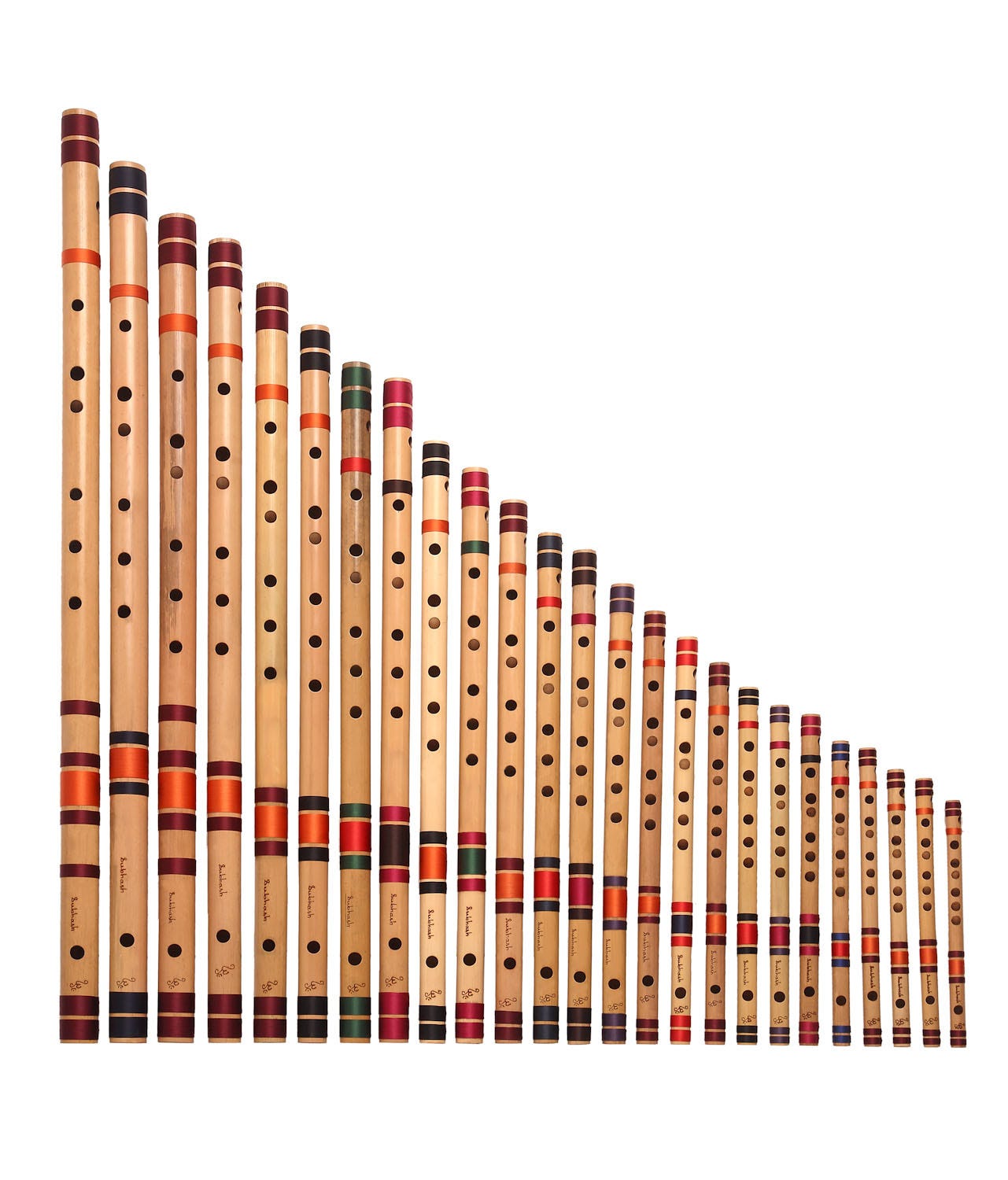
Then I came across flat notes, or komal notes. I had an A# flute, and it sounded horrible. I could not get proper control over the position of my fingers. Getting volume for komal notes was another challenge. Also, tar saptak notes sounded very airy and unpleasant. I could see many artists playing much longer flutes and producing very sweet sounding note
Thanks for reading! Subscribe for free to receive new posts and support my work.
So my experimentation with lengths started.
I bought E, F, and F# bass flutes and started practicing. I found that what you see in videos can be so deceptive. My fingers would not stretch, they would not close the holes every time, and the problem became worse. Then I discovered a certain flute holding style that gives you a stretched finger configuration, making it possible to play longer flutes. I experimented with this and found that my fingers had no muscles to close the holes. However, slowly, with repeated practice, I was able to play basic notes. It sounded better than short flutes, but higher octave notes were still a problem. Eventually, I found that a certain neck angle can help produce higher notes more easily. So this journey continued. Eventually, I was able to play an E flute, which is almost 30 inches. Still, most Bollywood songs are in C# or D, and that was out of my league. During this time, I wished I had access to a bansuri teacher, but being in a remote part of New Jersey, there was very little hope. Internet online classes were not an option at that time.
To cut a long story short, eventually I was able to produce sounds on D# and D flutes, at least full notes where no partial covering of holes is needed.
Komal surs, or half notes, were another story. Longer flutes had finger holes that were wider, so it was easier to partially cover a hole, but accuracy and volume were still a challenge. It took many observations, videos, and demos to figure out that there is no real shortcut. Constant practice with tanpura and a proper blowing angle are required to produce sweet sounding notes. Sadly, it does not automatically extend to other flutes. The moment you change the flute, it may need its own practice.
I never used tongue touches to play the notes. Around 2014, online classes had already started. I was fortunate to get online guidance from Pt. Milind Date. He guided me on the use of the tongue, like plucking a wire, so the initial attack sound is strong. He also polished many of my komal and shuddh notes.
Back to Small Flutes: Circle Complete
Although I was able to play things on E flute, the smaller flute like C, A# sounded pitchy specially for half notes. Creating accurate half note is lot more challenge on small flute , Also producing clear higher octave notes was a challenge.. so I now to leverage what was learnt on longer flute and apply to smaller flutes.. I had to practice the meend work , half notes , higher octave notes and tongue techniques on smaller flute.. Now I can play C# which is is about 19 inch with some accuracy, D, D# is still a challenge,.
The challenge doesn’t end there . I am now studying Raagas.There is a lagav of each note depending on raaga, specially komal notes. This needs to be practiced it on longer flutes and also on smaller flutes,
I guess this circle of practice is here to stay!